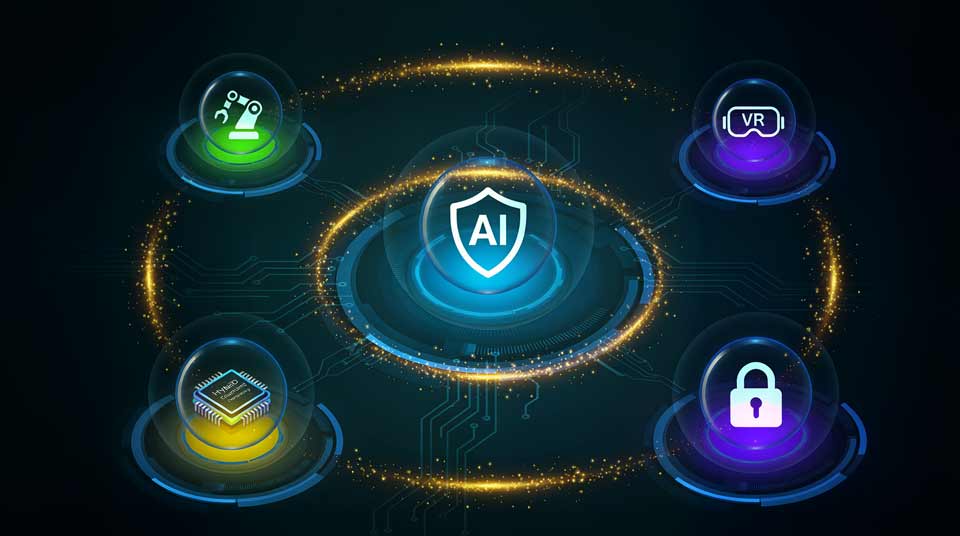
The technology landscape is evolving at unprecedented speed, with breakthrough innovations reshaping industries and redefining how we live and work. Here are the top 5 technology trends that are transforming our world right now.
1. Agentic AI: Autonomous Decision-Making Intelligence
What it is: Beyond simple chatbots and generative AI, Agentic AI represents a paradigm shift—systems that don’t just respond to instructions, but plan, execute, and make decisions independently.
Key Capabilities:
- Autonomous workflow automation for complex business processes
- Self-driving decision engines for supply chain, customer service, and fraud detection
- Predictive problem-solving that anticipates needs before they arise
The Impact: According to Gartner, by 2028, 15% of daily work decisions will be made autonomously through AI agents—up from 0% in 2024. This represents a fundamental shift from tools that assist humans to systems that augment and extend human capabilities.
Use Cases:
- Dynamic pricing optimization
- Autonomous customer support resolution
- Self-correcting manufacturing processes
- Intelligent resource allocation
2. AI Governance & Ethical AI Platforms
What it is: As AI adoption surges, organizations need robust platforms to ensure their AI systems are ethical, transparent, compliant, and accountable.
Core Features:
- Explainable AI (XAI) for transparency and trust-building
- Bias detection and mitigation tools
- Regulatory compliance tracking (EU AI Act, etc.)
- Audit-ready documentation and lineage tracking
Why It Matters: Without proper governance, AI deployment carries significant risks—from unfair algorithmic decisions to regulatory penalties. Responsible AI is no longer optional; it’s essential for sustainable innovation.
3. Post-Quantum Cryptography (PQC)
What it is: Quantum computing is moving from theoretical science to practical reality, threatening today’s encryption standards. Post-Quantum Cryptography provides the shield we need against quantum-powered attacks.
Critical Threats Addressed:
- “Harvest Now, Decrypt Later” attacks—where adversaries collect encrypted data now to decrypt later when quantum computers are available
- Legacy encryption vulnerabilities in finance, healthcare, and government systems
- Long-term data protection for sensitive intellectual property
The Timeline: NIST finalized the world’s first PQC standards in August 2024 (FIPS 203, 204, 205). Organizations must begin migration now—or risk decades of accumulated encrypted data becoming vulnerable. Under NIST’s transition timeline, high-risk systems are expected to transition much earlier than 2035, the general deprecation deadline.
4. Spatial Computing & Immersive Technology
What it is: Spatial computing is evolving from hype to reality, with devices like Apple Vision Pro and Meta Quest leading the charge. This trend extends beyond VR/AR into mixed reality, digital twins, and immersive collaboration platforms.
Market Trajectory: The global spatial computing market was valued at approximately $95-100B in 2023, grew to $142-185B in 2025, and is projected to reach over $2.6 trillion by 2036, representing one of technology’s most significant market shifts driven by enterprise adoption across manufacturing, healthcare, retail, and defense sectors.
Business Applications:
- Virtual team collaboration that feels “in the same room”
- Interactive product design and prototyping
- Training simulations for healthcare and manufacturing
- Retail experiences with virtual try-ons and showrooms
5. Hybrid Computing Architecture
What it is: The convergence of quantum, neuromorphic, and classical computing resources to solve complex problems that would take traditional systems exponentially longer to handle.
Key Benefits:
- Accelerated AI model training through specialized processors
- Optimized energy consumption for computationally intensive tasks
- Enhanced security through diverse computational approaches
- Real-time processing of massive datasets
Why It Matters: As computational demands explode—from climate modeling to drug discovery—hybrid computing architectures provide the efficiency needed to make breakthroughs in previously impossible timelines.
Strategic Recommendations
To stay competitive in this rapidly evolving landscape:
- Invest in AI Governance – Build frameworks for responsible AI deployment today
- Future-Proof Security – Implement post-quantum encryption and upgrade legacy systems
- Embrace Hybrid Architectures – Prepare infrastructure that can leverage emerging computational paradigms
- Train Your Teams – Upskill employees in spatial computing, robotics integration, and autonomous AI collaboration
The Bottom Line
The technology leaders of tomorrow are those who understand these trends today. The organizations that successfully integrate these technologies while maintaining ethical standards and competitive advantages will define the next decade of innovation.
Are your business strategies aligned with these emerging technologies? The window for strategic preparation is now.
Follow our Technology Insights series for ongoing coverage of innovations, implementation strategies, and industry analyses.